ABOUT US
1. Background and Scientific Foundation
Indonesia is a marine megabiodiversity country, home to more than 800 species of seaweed, making it the global center of tropical seaweed biodiversity. However, this vast potential remains underutilized, both in terms of conservation, genetic exploration, and downstream development based on science and technology. Over the past few decades, seaweed development in Indonesia has primarily focused on cultivation and conventional processing, while the application of advanced technologies such as molecular biosciences, biotechnology, and multi-omics approaches (genomics, proteomics, and metabolomics) remains very limited.
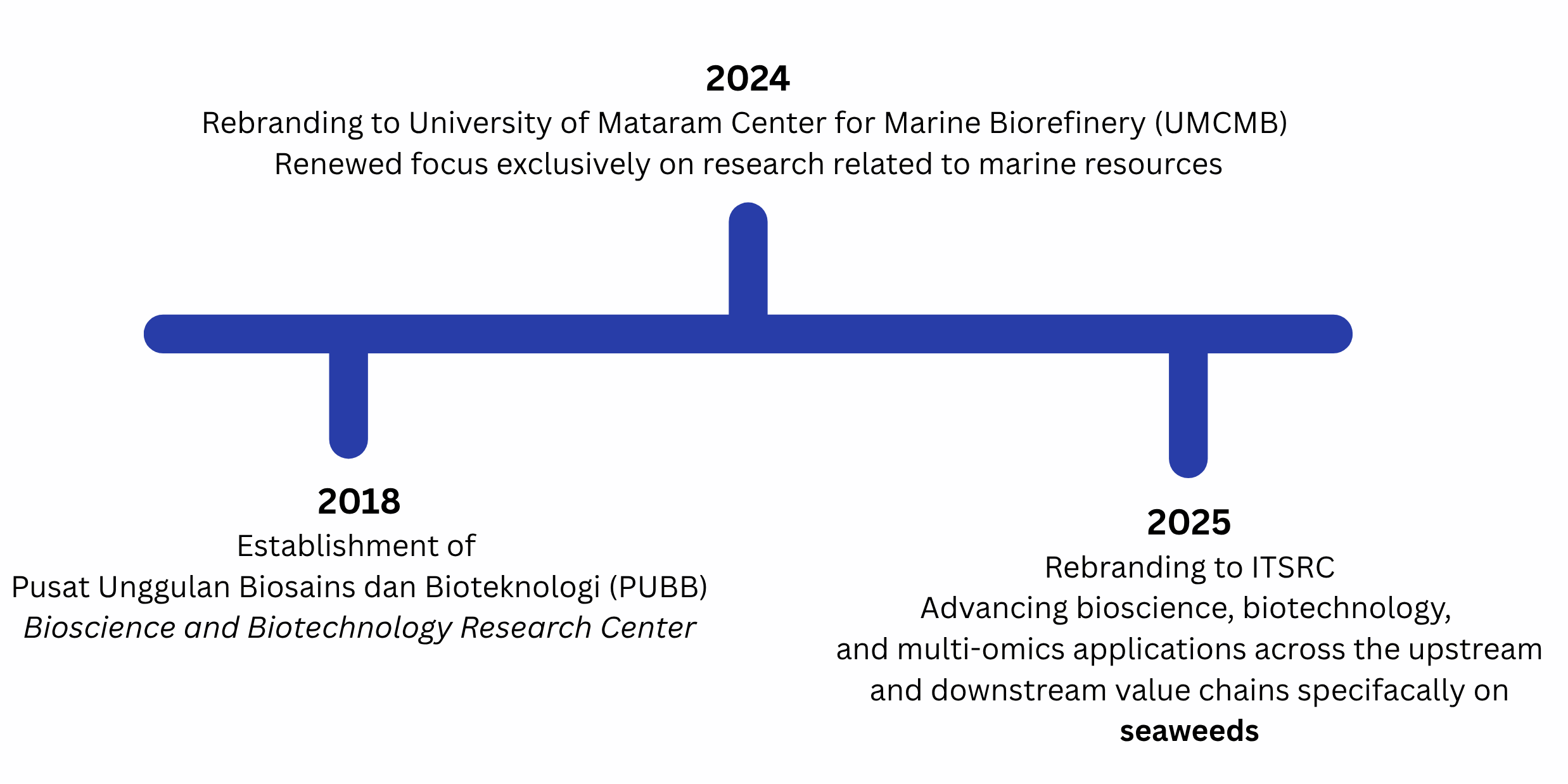
To address these challenges, there is a need for a leading research institution with a specific focus on seaweed research and innovation grounded in fundamental science and advanced technology. The University of Mataram International Tropical Seaweed Research Center (ITSRC), formerly known as the Bioscience and Biotechnology Research Center (PUBB) established in 2018, is committed to strategic seaweed research. By collaborating with national and international partners and supported by well-equipped laboratories and highly competent human resources, UMCMB aims to become a driving force in Indonesian seaweed research — generating not only new knowledge but also practical solutions and strategic national policies to support a sustainable blue economy.
Scientifically, the multi-omics approach enables the mapping of genetic characteristics, identification of bioactive metabolites, and molecular pathways of various seaweed species. This is essential for developing biobanks, discovering bioindicators, improving superior varieties, and advancing derivative products such as nutraceuticals, pharmaceuticals, and other biomaterials.
2. Institution and Leadership
The University of Mataram International Tropical Seaweed Center (UMCMB) operates under the legal foundation of the Rector’s Decree of the University of Mataram (Decree No. 3009/UN18/HK/2025), which is updated annually. UMCMB is led by Eka Sunarwidhi Prasedya, Ph.D., as the Head of the Center. At the university level, all Centers of Excellence in Science and Technology (PUI) are coordinated under the Institute for Research and Community Service (LPPM).
3. Vision & Mission
Vision:
To become a nationally and internationally recognized center of excellence in research, development, and downstream innovation of seaweed, based on biosciences, biotechnology, and multi-omics technologies, in support of an inclusive and sustainable blue economy
Mission:
-
To conduct cutting-edge research in seaweed biosciences, biotechnology, and multi-omics, focused on scientific discovery and innovation.
-
To establish and develop a seaweed genetic biobank as a strategic national resource.
-
To develop downstream models and commercialization strategies of research outputs to support the national seaweed industry.
-
To enhance human resource capacity through education, training, and international collaboration.
-
To serve as a strategic partner for the government and stakeholders in formulating national policies on seaweed biosecurity and conservation.
4. Research Focus and Activities
-
Seaweed Biodiversity and Genetics
Exploration and characterization of Indonesia’s seaweed biodiversity through genetic analysis using DNA barcoding and genomic technologies. -
Conservation and Genetic Biobank
Development of a genetic biobank for the preservation of seaweed germplasm. Studies on species adaptation and resilience to climate change and environmental stress. This also includes the application of molecular biotechnology for the development and breeding of high-value seaweed species or strains, and the production of superior varieties for cultivation through in vitro culture techniques. -
Exploration of Seaweed Bioactive Compounds through Integrated Multi-Omics Technologies
Identification, isolation, and validation of bioactive compounds with antioxidant, anti-inflammatory, antitumor, antimicrobial, antidiabetic, and other biological activities. Exploration of downstream potential of seaweed is carried out using an integrated multi-omics approach, including genomics, transcriptomics, proteomics, lipidomics, and metabolomics studies. -
Downstream Innovation and Product Development
Design of product prototypes based on research outputs (such as bioplastics, biofertilizers, and functional foods). Feasibility analysis and commercialization strategies based on the marine bioeconomy. -
Development of a National Taskforce for Seaweed Biosecurity
This activity serves as a strategic step to strengthen the protection of Indonesia’s seaweed resources from biotic and abiotic threats such as diseases, invasive species, and the impacts of climate change. The development of this national taskforce involves representatives from key ministries (Marine Affairs and Fisheries, Agriculture, BRIN), universities, local governments, seaweed farmer associations, and industry players. The mechanism includes the formulation of a national framework for seaweed quarantine systems, development of science-based biosecurity protocols, and the integration of data systems and rapid response mechanisms to extraordinary events such as seaweed disease outbreaks.
5. Expectations and Impact
Expectations:
-
To strengthen national bio-sovereignty through the responsible and sustainable conservation and utilization of Indonesia’s seaweed genetic resources.
-
To become a national and regional reference center for seaweed research based on advanced technologies such as genomics, proteomics, and metabolomics.
-
To drive the transformation of the seaweed industry from raw commodity-based production to high-value downstream products such as nutraceuticals, biomaterials, and biopharmaceuticals.
-
To foster strategic collaborations among academia, industry, policymakers, and the international community.
-
To produce excellent and innovative human resources in the fields of marine biosciences and biotechnology through training, research, and internship programs.
Expected Impact:
-
Improved quality and productivity of seaweed through the application of precision technologies and molecular approaches.
-
Development of competitive seaweed-based innovations for the global market, supporting food security and public health.
-
Strengthening of Indonesia’s marine research ecosystem through data-driven, collaborative, and industry-relevant efforts.
-
Reduced risk of cultivation failure through early disease detection and the development of superior strains tolerant to extreme environmental conditions.
-
Contribution to a sustainable blue economy by integrating conservation, production, and downstream processing in a holistic manner